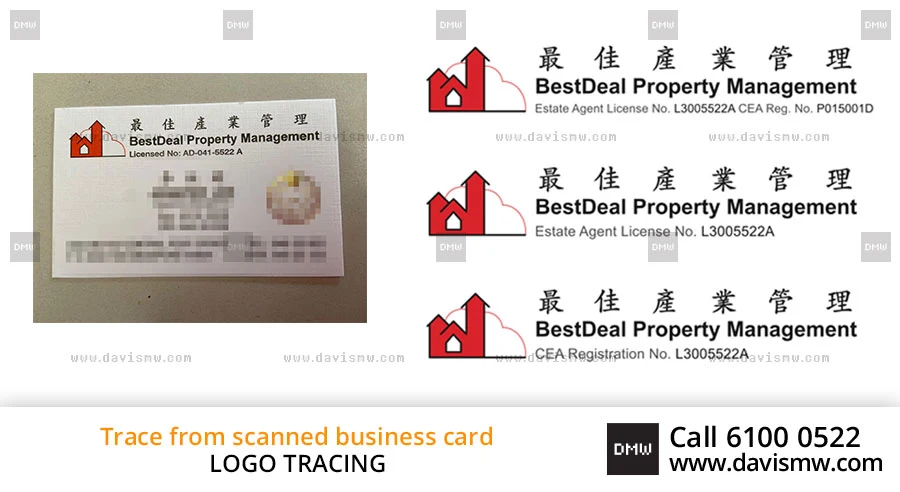
Can you recreate my logo from an old business card?
Absolutely! With modern graphic tools and professional design skills, we can reproduce your logo from an old business card. It's important to note, however, that the final quality heavily depends on the quality and complexity of the original image. We'll strive to recreate it as accurately as possible, and if required, we can also work together to refine or update the design according to your current business needs.
What is the best file format to request for the logo after it has been recreated?
Once the logo has been recreated, it is recommended that you request it in several different file formats to suit various purposes. The most important formats are:
Vector formats such as AI, EPS or SVG. These files are scalable without any loss of quality, making them ideal for large-format printing and instances where high resolution is crucial.
High-resolution raster files like PNG or JPEG. These files are perfect for digital use on websites or social media. PNG files have the added benefit of a transparent background, making them versatile for use on different backgrounds.
A PDF version. PDFs are universally viewable and useful for sharing your logo in various professional contexts. Usually, we will provide an editable PDF file.
Remember, having various file types ensures your logo is ready for use. Also not to forget that we will also be providing the logo in two colour modes RGB for Screen & CMYK for Print. Pantone Colour depends on the requirement.
What is a vector? My printer often requests a vector logo for printing tasks.
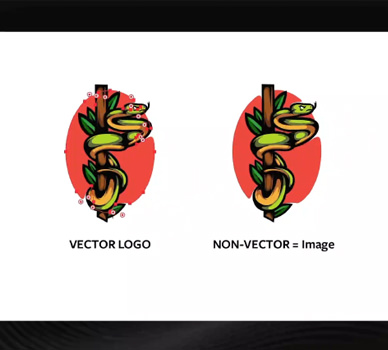
A vector is a type of graphic that uses mathematical formulas to render its design. Unlike raster graphics, which are made up of pixels, vectors comprise paths or lines that can be easily scaled. This means that no matter how much you enlarge or reduce a vector graphic, and it will maintain its quality and not become pixelated.
Printers often ask for vector logos precisely due to this scalability. Printers may need to adjust the size of your logo to fit different materials or layouts, and a vector file ensures the logo will remain crisp and clear at any size.
Common vector formats include .EPS (Encapsulated PostScript) and .SVG (Scalable Vector Graphics), so if your printer asks for a vector logo, they typically refer to these file types.
What is an SVG? My web and mobile application designers often request this format.
SVG stands for Scalable Vector Graphics. It is a vector image format for two-dimensional graphics with support for interactivity and animation. The SVG specification is an open standard developed by the World Wide Web Consortium (W3C) since 1999.
SVG images and their behaviours are defined in XML text files, which means they can be searched, indexed, scripted, and compressed. Moreover, SVG images can be created and edited with any text editor and drawing software.
The main advantage of SVG files over other formats (like JPEG or PNG) is scalability. As vector graphics, SVG files maintain quality and detail at any scale, making them perfect for responsive web design and use in mobile applications. They can be scaled up or down as needed while remaining crisp and clear, making them particularly useful for logos, icons, and other graphics that need to look good at various sizes and resolutions.
Can my 3D logo be traced and recreated?
Tracing or recreating a 3D logo is a more complex process than working with a 2D design, but it is certainly achievable. Depending on the complexity of your 3D logo, we may utilise 3D modelling and rendering software to replicate the design accurately.
However, it's essential to understand that a 3D logo can't be fully represented in traditional vector formats like SVG or EPS, primarily for 2D graphics. For 3D models, we would typically provide files in formats such as .OBJ or .STL, or as a rendered 2D image from a chosen perspective.
If you want to use your 3D logo in a wide variety of mediums — including digital platforms, print, and physical products — we recommend also having a 2D version of the logo designed. This ensures maximum flexibility for your branding across different formats and uses.
My logo is a painted image, and I don't have a sharp version. Can it still be traced and recreated?
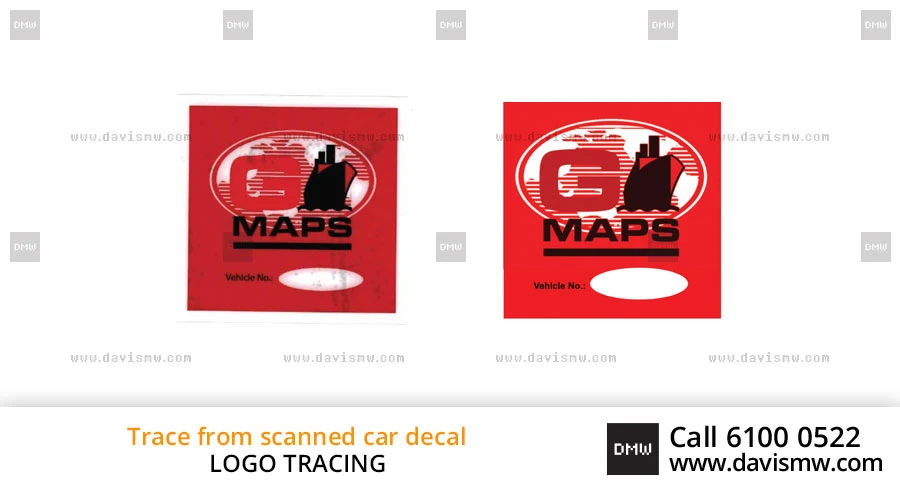
We can still work with your painted image to recreate your logo. The process may involve digital painting or illustration techniques rather than simple tracing, especially if the image isn't very clear. While we can't promise a pixel-perfect match in such cases, we can certainly reproduce the essence and aesthetic of the original painting and possibly refine it in the process.
It's worth noting that the quality of the final digital logo will heavily depend on the image quality we start with. Please let us know if you can provide a high-resolution scan or photograph of the painting and if there are elements like particular colours or brushstrokes that are important to preserve. We're committed to delivering a logo that reflects your original design as closely as possible and meets your current business needs.
(The process is meticulous, and it will incur significant expenses.)
Can you identify the font in my logo, or will you trace it?
In many instances, we can identify the font used in your logo using various font identification tools and our expertise in typography. We can likely find a match if the font is a common or commercially available typeface.
However, if the font used in your logo is highly customised, hand-drawn, or otherwise unique, we may not be able to identify an exact match. In such cases, we would typically trace the letters to recreate the typography as accurately as possible. Alternatively, we can suggest similar or complementary fonts that might work for your logo if the exact font can't be identified or replicated.
Please remember that the quality and clarity of the provided image can significantly affect our ability to identify or recreate the font accurately.
If my logo uses a commercially purchased font, can you still trace it?
Yes, whether a font used in your logo is free or commercially purchased doesn't impact our ability to trace it. If you don't have access to the original font file, or it's a commercial font that requires purchase, we can still trace the text part of your logo to replicate it.
However, it's important to remember that while tracing can recreate the visual appearance of your text, it won't provide you with a functional, typable font. Suppose you must type in the same font for other branding elements (e.g., website headlines or print materials). In that case, it might be worth considering purchasing the font if it is commercially available.
Please also note that the precision of the tracing will depend on the quality and resolution of the provided logo image. Higher-quality images will yield more accurate results.
Disclaimer: It is imperative to note that our obligations do not encompass the legal requirement to use a commercially licensed font without due payment. The onus of adhering to such legalities pertaining to using fonts in the logo rests solely with the client, as the logo is deemed an asset under their ownership. Our engagement is confined to executing the tracing task and does not extend to providing brand consultation to the client.
My logo is in PSD format, and I cannot view it. Can you still trace and recreate it?
The good news is a PSD file (Photoshop Document) is already a high-quality source file that we can directly work with, so there is usually no need for tracing. A PSD file can be opened and manipulated using Adobe Photoshop, and elements such as text, shapes, and colours can be directly extracted and used to recreate your logo in other formats (like SVG or EPS for vector graphics). But we will need to open your file and check the size and the resolution to determine if it is a high-quality source file.
Suppose you cannot view your logo because you don't have Photoshop or compatible software. In that case, we can help you convert the PSD into more accessible formats, such as JPEG or PNG for preview purposes and SVG or EPS for scalable vector versions of your logo. Tracing would only be necessary if the elements within the PSD are rasterized (flattened into pixel-based layers) and can't be directly extracted.
What is a TIFF file?
TIFF, or Tagged Image File Format, is a file for storing raster graphics images. Many imaging and graphics applications widely support it, and it is commonly used for storing high-quality images.
One of the main benefits of TIFF files is that they can retain a high level of detail and do not lose quality over time or after multiple saves, as they support lossless compression. This makes them ideal for storing images that need editing and re-saving multiple times, such as professional photographs or detailed artwork.
However, because TIFF files prioritise quality over file size, they can take up a significant amount of storage space, making them less suitable for uses where file size is a concern, such as web use. Some basic image-viewing software may also not support them, making sharing and viewing these files more challenging for those without the appropriate software.